Sustainable Web Design in 2026
With AI flooding the market and authoritarianism on the rise, where does sustainable web design fit in? What does it take to create more sustainable digital products and services that meet the needs of people, planet, and shared prosperity at a time when those things are deprioritized?
Much has happened since we originally published this article in 2013—one of the first on the web to cover sustainable web design. At the time, if people considered sustainability at all in a digital context, they often thought the web was a more sustainable medium because it replaced paper. We have since learned that this couldn’t be further from the truth.
Also, tactical articles about how to merge responsible environmental, social, and governance (ESG) sustainability principles with digital products and services were few and far between. Mightybytes set out to change this in 2013. Despite sometimes significant headwinds, we have never looked back.
In fact, the article below includes more business strategy and organization design recommendations than previous versions. We have come to learn that without leadership support, especially at a time of rising authoritarianism, sustainable web design efforts are often not appropriately prioritized or resourced.
Table of Contents
- Web Sustainability vs. Information Crisis
- The Big Question
- What is Sustainable Web Design?
- What is Corporate Digital Responsibility?
- Understanding Risks & Benefits
- Web Sustainability FAQs
- Your Digital Footprint
- Case Study: Climate Action
- Digital Emissions Primer
- Stakeholder Mapping Guide
- The Models we Use
- Digital Life Cycle Assessments
- AI and Sustainable Web Design
- Digital Supply Chains
- Web Sustainability Guidelines
- WSGs Primer
- WSGs Case Study
- Business & Product WSGs
- UX Design WSGs
- Web Development WSGs
- Hosting & Infrastructure WSGs
- Greenshouting Guide
- Digital Greenwashing Guide
- Operationalizing Sustainable Web Design
- Improving Digital Resilience
- Personal vs. Producer Responsibility
- Exploring Responsibility
- Call to Action: Responsible Tech Advocacy
- Tech Advocacy Toolkit
- Sustainable Web Design FAQs
- Sustainable Web Design’s Hopeful Future?
We have travelled a long way from the idealism of Tim Berners-Lee and the birth of the world wide web, when the hope was to offer a free service that would “unlock creativity and collaboration on a global scale”.
— Katharine Viner, How to survive the information crisis: ‘We once talked about fake news – now reality itself feels fake’, The Guardian
Web Sustainability vs. Information Crisis
Now, as we barrel toward the 2030 U.N. Sustainable Development Goals deadline:
- Hundreds of independent and mainstream media outlets alike regularly cover the environmental impact of tech, generative AI, the web, and particularly the ecosystem and community impacts of hyperscale data centers.
- Dozens of online communities focus on topics like green software and climate action in tech.
- Tech standards bodies like IEEE and the World Wide Web Consortium weave sustainability into their specifications, which offers the potential to influence education, awareness, tooling, and, perhaps most importantly, legislation and regulatory guidance.
- Our industry even now has a conference dedicated to sustainability in tech.
However, while interest in web sustainability continues to grow, so too do the ESG impacts of emerging technologies rushed to market in the name of innovation and progress. The “move fast and break things” set has spawned an age of vibe coding, runaway automation-fueled spam, enshittified marketing, AI-driven ethics and sustainability issues, and, perhaps most importantly, an information crisis the likes of which the world has never seen.
The rapid development of digital technologies, including AI, is having a significant impact on the social, economic, and political life. Yet, while presented as milestones in innovation and progress, these technological transformations have also introduced mechanisms of control, forms of organization, and ideological patterns that bear striking resemblances to historical fascist phenomena.
— Mark Coeckelbergh, Technofascism: AI, Big Tech, and the new authoritarianism
Big Tech and Authoritarianism
This information crisis has, among other things, fueled the rise of authoritarianism. Big Tech companies are some of the richest and most powerful in the world. Most (all?) web teams use Big Tech tools somewhere in their production pipelines.
Plus, many Big Tech companies have rolled back their Net Zero commitments in exchange for aggressively pursuing AI development. Unfortunately, these companies also regularly fund fascism and increase risk for organizations that use their products and services.
These actions have prompted a growing digital sovereignty movement in the European Union and around the world. We cannot talk about sustainable web design without acknowledging this. With that in mind…
The Big Question
Can we collectively muster the will and resources necessary to design a more humane and sustainable web that works for everyone (including the planet)? If so, what will that take?
What is Sustainable Web Design?
Sustainable web design is an approach to creating digital products and services that puts people and planet first. It respects the principles of the Sustainable Web Manifesto, which calls for an internet that is:
- Clean: Services provided and used will be powered by renewable energy.
- Efficient: Products and services will use the least amount of energy and material resources possible.
- Open: Products and services will be accessible, allow users to control their data, and enable the open exchange of information.
- Honest: Products and services will not mislead or exploit users.
- Regenerative: Products and services will support an economy that nourishes people and the planet.
- Resilient: Products and services will function in times and places where users need them most.
More concisely, sustainable web design is a hybrid blend of ESG principles and techniques for web product teams that include:
- Environmental stewardship and conservation principles
- Social and economic justice
- Responsible digital governance, data governance, and stakeholder-driven design and development practices
Interdisciplinary Sustainable Web Design Practices
Sustainable web design comes to life across performance-driven strategy, usability, and development tactics. It embraces interdependence and systems thinking while also prioritizing accessibility, optimization, and efficiency at the image, font, or even pixel level.
Its tactics cross multiple disciplines, including:
- Product management
- Business strategy
- User experience design
- Accessibility
- Security
- Privacy
- Web development
- Energy, water, and resource use
- Climate strategy
- Performance measurement
- Impact reporting
- And many others…
Sustainable web design is also part of a larger Corporate Digital Responsibility (CDR) strategy that includes social, economic, and environmental practices. CDR improves organizational resilience and governance when aligned with seven core principles.
What is Corporate Digital Responsibility?
Related content: This overview covers how organizations can use CDR to foster sustainable digital transformation based on seven core principles. It includes multiple examples relevant to sustainable web design.
Understanding Risks & Benefits
Currently, political chaos and technological disruption reframe how business is conducted. This is challenging on the best of days. However, embracing sustainability can improve stability and resilience during times of uncertainty. This includes the digital products you create and manage.
To enable this, consider designing ESG principles into your organization’s operational DNA across teams and departments. Here’s where innovation blooms, better teams are built, and digital products, services, policies, and programs that work for people and planet come to life.
Plus, the implementation looks different from organization to organization. Sustainable web design is relevant to people and organizations of all stripes:
- Individual freelancers
- Multinational companies
- Nonprofit charities
- Government agencies
- Marketing, advertising, or product teams
- Tech or SaaS startups
With that said, in reviewing both the benefits of embracing sustainability and the risks in not doing so, common themes arise.
Organizational Risks
Unfortunately, organizations cut corners on web and tech projects all the time. Budgets are slashed, unforeseen challenges arise, people move on, priorities shift. This happens for many reasons. Risks often include:
- Resources: Organizational decisions about how (or if) to resource digital products and services can hobble long-term continuous improvement efforts. This undermines customer and other stakeholder relationships, increasing security risks, and impeding ROI evaluation efforts.
- Digital supply chains: Third-party services in the form of APIs, SaaS products, plugins, widgets, and so on require ongoing due diligence. Not doing so often results in technical debt and data inequality, as well as numerous other problems.
- Accessibility: When people with physical and cognitive disabilities can’t access information, you alienate customers and increase legal risk.
- Data privacy: By not asking for informed consent, you also increase legal risk related to ever-changing data privacy laws.
- Humans-in-the-loop: Lack of human oversight on AI or other emerging technology projects can undermine security, privacy, sustainability, and drive a host of other issues.
- Mis/disinformation: Also, AI tools hallucinate. Plus, discord—often fueled by false information—drives revenue on social platforms. This undermines trust and the very fabric of society.
Organizations that address these and related issues will reduce risk. Good leadership and governance are critical, as is stakeholder engagement.
Tactical UX design and web development techniques play important roles. However, sustainability is a holistic, interdependent practice that crosses teams, disciplines, and departments. Systems thinkers and service, UX, or organization designers will thrive in this space.
Web Sustainability FAQs
Related content: Get answers to commonly asked web sustainability questions in this list.
Benefits of Sustainable Web Design
Conversely, the benefits to adopting web sustainability practices are far-reaching. Plus, many sustainable web design practices also align with common business and finance goals:
- Purpose & trust: Coupled with a clear purpose, adopting sustainability principles requires increased transparency, accountability, and reporting. This helps to build trust with key stakeholders, which holds multiple benefits.
- Performance & efficiency: You can’t improve what you don’t measure. A responsible focus on continuous improvement over time drives ongoing performance and efficiency gains. In turn, this can reduce costs, improve usability, and build customer loyalty.
- Data: Also, sustainable web design often improves an organization’s relationship with its data. This reduces risk, helps teams build capacity, and makes long-term governance easier to manage.
- Cost: Many sustainable web design practices reduce the number of systems, tools, and data points an organization needs to manage. This can reduce costs, sometimes significantly if a provider charges based on amount of data stored or transferred.
- Workplace culture: Finally, by focusing on responsible practices and engaging stakeholders, organizations also notice better team cohesion and collaboration. This improves workplace culture and reduces turnover.
Your Digital Footprint
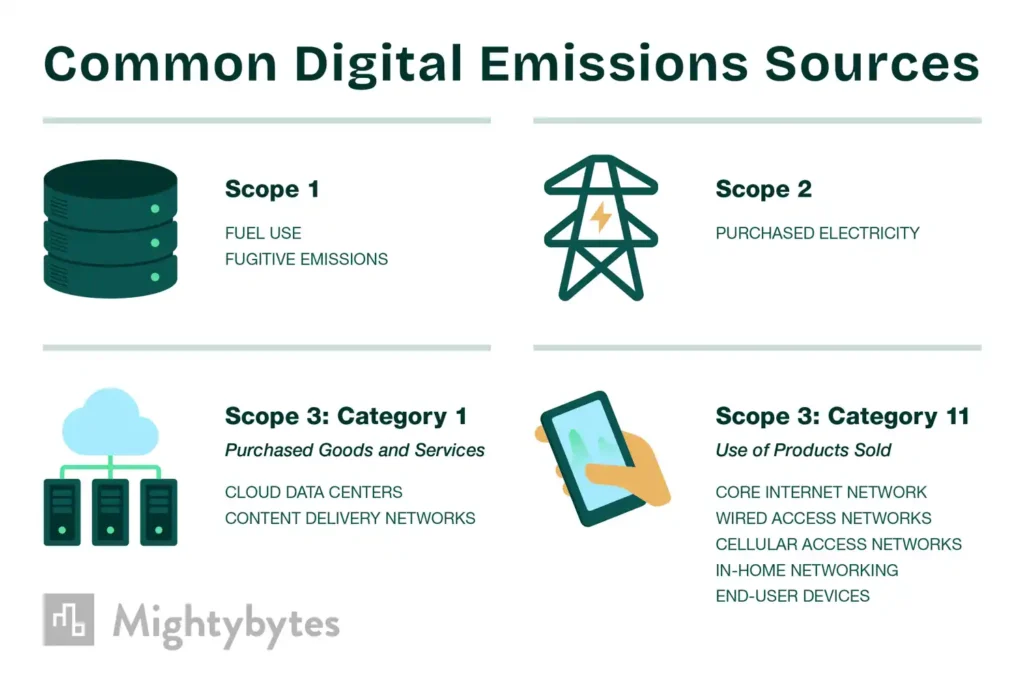
Next, an organization’s digital footprint grows as it:
- Purchases or rents hardware, cloud accounts, or virtual machines,
- Produces content, creates landing pages, and runs advertising, email, or marketing campaigns,
- Collects and stores data from online business or marketing activities,
- Designs, builds, and launches websites, mobile apps, or other digital products and services,
- Hosts or streams virtual workshops, meetings, webinars, videos, podcasts, or engages in other online group activities,
- Buys SaaS subscriptions, AI tools, or invests in other third-party services necessary to meet evolving business and operational needs.
Each activity above uses resources and produces waste. If you produce digital products or services, you’re responsible for both the embodied and operational impacts they create. If you use digital products and services, you are responsible for the impacts created by your use (often related, but not limited to, Scope 3 emissions).
… between 60 percent and 73 percent of all data within an enterprise goes unused for analytics. And that’s despite the fact that more companies are talking about big data, using technology to capture more data, and acknowledging the value of this information.
— Jeff Barrett, Up to 73 Percent of Company Data Goes Unused for Analytics. Here’s How to Put it to Work, Inc. Magazine
Digital Footprints & Good Governance
Compounding this, many organizations still silo digital teams in their own departments. Yet, as previously noted, digital, data, and sustainability skills are universal and intersectional across teams and departments. Depending on an organization’s focus, these teams are sometimes also significantly under-resourced. This causes multiple operational problems.
Additionally, from a data pipeline perspective, under-resourced digital departments are also often poorly governed. This can lead to huge amounts of ‘dark data’ that is collected but never used.
Related, millions of organizational websites are cluttered with unread or out-of-date content. This is despite good content governance and content audits being considered ‘best practices’ for decades now. Unfortunately, data disposal strategies to address these issues are often nonexistent or ineffectual.
However, it is within most organizations’ means to align data or digital marketing strategy with climate strategy.

Case Study: Climate Action
This case study from B Lab U.S.-Canada shows how good governance transforms digital work into meaningful and measurable climate action.
What’s more, these governance issues frustrate users, waste energy, and cost time and money. This directly impacts an organization’s bottom line and long-term sustainability.
The environmental impact of an organization’s physical space, products, and business practices are important to track and assess. However, don’t neglect the footprint of online properties as part of this process.
Digital Emissions Primer
Related content: Not sure where to start with digital emissions? This primer can help.
Carbon Tunnel Vision in Sustainable Web Design
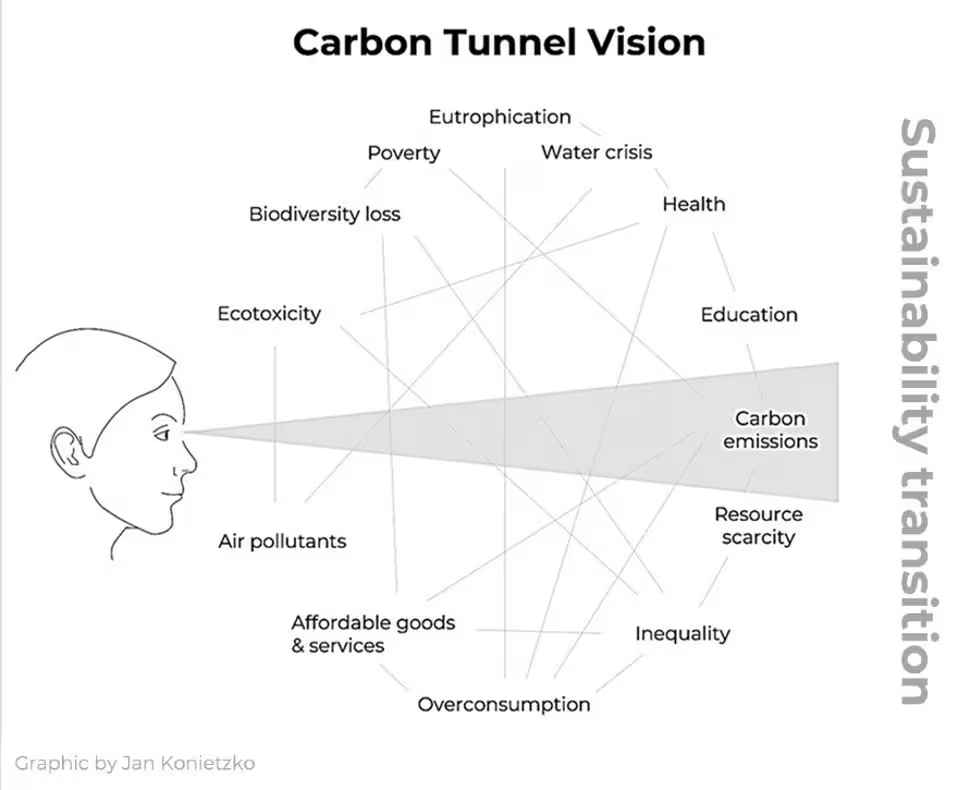
Often, well-intentioned organizations focus solely on decarbonization. Unfortunately, this carbon tunnel vision misses significant opportunities to make progress on other important issues. These issues can include:
- Affordability
- Inequality
- Resource scarcity
- Pollution
- Consumption
- Biodiversity loss
- Poverty
- Education
- And so on…
How an organization addresses these issues depends on its business model, products, services, supply chain, operations, and other elements. Some directly overlap with digital products, services, policies, and programs. For others, the correlation might be further afield.
Sometimes, the most straightforward way to contextually understand these issues is to learn how key stakeholders are affected by them.
Stakeholder Mapping Guide
Related content: Understand the material needs of affected parties in your business ecosystem. This comprehensive guide includes key workshop activities.
All models are wrong, but some are useful.
— George E.P. Box and Norman R. Draper, Empirical Model Building and Response Surface
The Models we Use
What’s more, website carbon ‘calculators’ are a dime a dozen these days. Freely available, open source tools like the Sustainable Web Design Model, which we helped create with Wholegrain Digital, the Green Web Foundation, and others lower the barrier to entry for evaluating web sustainability. These models are incredibly useful to educate and raise awareness about digital emissions and related topics.
However, they also don’t often represent the entire picture. Data disclosure gaps still exist from most providers. Some models make assumptions to fill in those gaps. Unfortunately, when people present data these models produce as absolute without acknowledging this, confusion and misinformation spread.
Instead, use these tools to create more clarity around data gaps and assumptions. Be crystal clear in how you present this information (see the Content and Data Strategies section below). Conduct more rigorous evaluations whenever possible.
Digital Life Cycle Assessments
Related content: Understand the impact of a digital product or service throughout its life-cycle using this rigorous methodology.
AI and Sustainable Web Design
Also, most AI tools use the web as a delivery mechanism. This might be via chatbots or other agentic solutions, but can take shape in other ways too.
For example, many tools used to create digital products and services are now AI-enabled. From design tools like Figma to agentic or ‘vibe’ coding tools like Copilot or Claude Code, this presents many challenges.
What’s more, these tools—and the practices associated with them—get better every day. From a sustainability perspective, this affects any product or service’s embodied and operational impacts.
Unfortunately, we’re now in the same place with how we understand AI’s ESG impacts as we were ten years ago when evaluating web sustainability. None of the common AI providers disclose data we need to assess embodied or operational emissions, water or energy use, or other impacts. This makes it challenging to evaluate the impact of AI-enabled practices.
Eventually, tools, training, legislation, and new models will fill in existing data disclosure gaps. Until then, conscientious product teams can craft responsible AI policies and clear supplier codes of conduct. This will help you find more ethical partners and define what is or isn’t acceptable for an organization’s AI impacts.
Digital Supply Chains
Related content: Third-party suppliers, including AI tools, can represent a large portion of an organization’s environmental impact, especially for Scope 3 emissions. Unfortunately, this is often out-of-sight and out-of-mind for product teams. Learn what you can do in this article.

Web Sustainability Guidelines
W3C’s Web Sustainability Guidelines are the most comprehensive set of recommendations for creating and managing more sustainable digital products and services.
In 2023, the World Wide Web Consortium’s Sustainable Web Interest Group released a first draft of the Web Sustainability Guidelines (WSGs). Since then, the specification has undergone hundreds of revisions and is one of the most comprehensive web sustainability resources available.
The Web Sustainability Guidelines might arguably be the most important asset in your sustainable web design toolkit.
80
Guidelines
Guidelines cover techniques for web teams managing digital products and services.
225
Success Criteria
Success criteria help you meet guidelines based on various sustainability aspects.
2,706
Resources
Resources provide evidence to reinforce claims and assist with guideline implementation.
200
Contributors
People from 25+ countries added their experience and expertise to shape the guidelines.
WSGs Primer
Related content: Want to learn about the Web Sustainability Guidelines but don’t have time to read the entire specification? This primer can help.
The guidelines are broken down into role-based categories, including:
- Product and business strategy
- User experience design
- Web development
- Hosting and infrastructure
The group is on track to publish this specification as an official W3C Note before the end of 2026. Once this happens, the WSGs can meaningfully influence tooling, education, and legislation in jurisdictions around the world in the same way that W3C’s Web Content Accessibility Guidelines (WCAG) do.
Let’s take a look at how each section in the Web Sustainability Guidelines applies to sustainable web design.
WSGs Case Study
Related content: This detailed case study shows how Mightybytes used W3C’s Web Sustainability Guidelines to drive our own website redesign.
Business Strategy & Product Management
The questions below shed light on how sustainable web design aligns with an organization’s business, finance, governance, and sustainability goals.
How does web sustainability apply to business strategy and product management?
Unfortunately, sustainable web design practices might stall or fail if your organization doesn’t offer some sort of institutional support. Digital or web sustainability initiatives are most successful when leadership supports the resources, teams, and policies needed for product teams to do their best work without sacrificing sustainability gains.
Fortunately, web sustainability intersects well with many performance indicators that business and product leaders already care about, such as:
- Efficiency and performance improvements
- Reduced risk
- Revenue increases
- Cost decreases
- Better customer relationships
- Improved resilience
- Stronger workplace culture
- And many others…
Moreover, when an organization’s business model intersects with both financial and sustainability goals, opportunities exist with various stakeholder groups to create shared value across communities and ecosystems.
1. How are sustainable business and product strategies in digital different from traditional business and product strategies?
Defining the role of sustainability in business is beyond the scope of this article. However, specific to the context of digital transformation, sustainability and regenerative business practices can empower organizations to innovate and redesign how they create value.
As an active member of the global Certified B Corp community, we’re likely biased here. However, we have also seen firsthand how sustainability can transform organizations. When partnered with collective action and digital transformation initiatives, the results are powerful.
2. How can I get started with sustainable business strategy and product management on the web?
To redesign how you work, align your organization’s products, services, policies, and programs with a vision that supports a just and more sustainable future. Good collaboration and participatory design practices are well suited to jumpstart this transformation. Be sure to incorporate important stakeholder perspectives into the process. This will build trust, transparency, and accountability.
Start with defining your purpose and framing a problem to solve. The most viable problems exist at the intersection of your business model, digital initiatives, and sustainability goals. In exploring this space, you can more quickly realize ROI on your efforts. Also, resources like the Climate Product Leaders Playbook can help your team fold responsible product management practices into the mix.
Business & Product WSGs
Related content: Business strategy and product management in the Web Sustainability Guidelines help leaders make more educated decisions to support web sustainability across teams, projects, and departments.
User Experience (UX) Design
Below are some frequently asked questions about the relationship between sustainable web design and user experience design.
1. How does sustainability apply to UX design?
A great user experience helps people accomplish tasks quickly and provides meaningful interactions without confusion or barriers. Sustainable UX design can also help people make more responsible choices that better support the needs of communities and ecosystems.
2. How is sustainable UX design different from regular UX design?
For several decades, good UX design relentlessly focused on users’ needs. This has led to sometimes problematic consequences, unintended or otherwise.
For example, AirBnB set out to make it easier and more cost-effective for people to find a place to stay. However, this led to reduced housing availability and the erosion of local communities. Similar examples exist with Uber and others.
By considering interdependence and a broader range of stakeholder perspectives that include communities and ecosystems in the design process, sustainable UX design can meaningfully address long-term impacts of design decisions on society and the environment.
3. How can I get started with sustainable UX design?
First, take a look at your organization’s existing digital products and services—your website(s), web and mobile apps, client portals, marketing platforms, and so on. Given the criteria above, are they still fit for purpose? If not, perhaps it’s time to reconsider your design processes.
Often, a product or website redesign offers great opportunities to learn valuable lessons about making UX design practices more sustainable. For example, common design processes like using typography and fonts, experience and journey mapping, managing image formats and media compression, and so on can be revamped to more effectively incorporate sustainability principles.
The Sustainable UX Network offers many resources in this area. Also, review specific UX design recommendations in the Web Sustainability Guidelines below.
UX Design WSGs
Related content: User experience design strategies in the Web Sustainability Guidelines improve usability, streamline user journeys, and help people understand the ESG impacts of their online choices.
Web Development
Next, the questions below offer answers about how sustainable web design relates to web development.
1. How does sustainability apply to web development?
It is a common misconception that sustainability in web development is just another way to describe performance optimization. Yes, performance and efficiency are important to web sustainability. However, they are just a small part of the sustainability equation.
Systems thinking for harms and threat modeling, knowledge sharing to combat the risk of ‘deskilling’ among developers due to an over-reliance on tools (like AI) over foundational knowledge, long-term commitments to reducing technical debt, and intersectional skills (see below) also play important roles.
2. How is sustainable web development different from regular web development?
In a perfect world, the two would be synonymous. However, in absence of that, elements of sustainable web development include:
- Risk assessment, especially with potential third-party code libraries and frameworks,
- Implementing potential energy-saving features like dark mode or energy grid awareness,
- Prioritizing intersectional features like accessibility, security, and data privacy, and
- A rigorous focus on reducing energy consumption and emissions, which often includes performance and efficiency mentioned above, plus writing cleaner code that requires less processing power.
3. How can I get started with sustainable web development?
Most existing websites or applications provide opportunities for improvement. Start there. For example, minify code, remove unnecessary scripts or assets, use smart caching strategies, reduce the number of server requests, and compress files like images, video, and text.
Longer term, set page weight or performance budgets, conduct regular audits over time, and reduce reliance on third-party services, especially if they aren’t hosted with providers that utilize renewable energy.
Web Development WSGs
Related content: Web development recommendations in the Web Sustainability Guidelines help front- and back-end web developers improve performance and efficiency and lighten data payloads, in turn reducing the burden on hardware resources.
Global AI data center power demand could reach 68 GW by 2027 and 327 GW by 2030, compared with total global data center capacity of just 88 GW in 2022.
— Konstantin F. Pilz, Yusuf Mahmood, Lennart Heim, AI’s Power Requirements Under Exponential Growth, RAND

Hosting, Infrastructure, Systems
Below are some ways that sustainable web design intersects with hosting, infrastructure, and the technology systems used to support web-based products and services.
1. How does sustainability apply to hosting, infrastructure, and systems?
Over 6 billion people—nearly 75% of the world’s population—use the internet worldwide. We rely on a vast array of networking and technology systems to deliver value:
- In particular, generative AI’s rapid growth drives enormous amounts of energy use, fueling comparable increases in GHG emissions. As mentioned previously, most AI interactions take place on the web.
- Plus, AI’s increased power requirements burn out chips faster, contributing to a rapidly rising global e-waste problem that could exceed 82 million metric tonnes by 2030. Only a small percentage of this waste is recycled. This results in billions of dollars lost in valuable (and often toxic) materials.
- What’s more, surveillance, AI, and other data-intensive technologies contribute the growth of nearly 22 billion connected devices.
To address this unprecedented growth in ways that support meaningful action, organizations can use sustainability to drive responsible decision-making. In addition to supporting personal and producer responsibility, this can also bring about cost and risk reductions, especially when emissions reporting is mandatory.
2. How is sustainable infrastructure different from traditional infrastructure?
In the simplest terms, powering infrastructure with renewable energy constitutes a significant shift from traditional infrastructure. However, finding greener hosting is not the only factor in driving more sustainable infrastructure. Others include:
- Managing resource utilization, moving compute workflows to cleaner grids, and managing power purchase agreements,
- Optimizing configurations for caching, compression, error handling, logging, etc.,
- Handling operational tasks in ways that improve efficiency and enable swift issue detection,
- And many others…
3. How can I get started with sustainable hosting, infrastructure, and systems?
Understanding the technology systems your organization relies on to deliver value can help you make more responsible choices in how you design, procure, and manage solutions. For many organizations, this might require working with suppliers to retool existing tech or marketing stacks. However, open source tools to optimize server-level sustainability exist as well. Focus first on:
- Finding ethical partners with clear sustainability statements
- Consolidating compute and resource usage
- Powering down idle servers, processors, accounts, etc. when not in use
- Conducting regular audits to improve performance over time
Hosting & Infrastructure WSGs
Related content: Hosting & infrastructure techniques in the Web Sustainability Guidelines build sustainability principles into procurement, management, and optimization decisions for digital infrastructure.
Sometime in the not-too-distant future, sustainability won’t be a standalone department; it will be an integrated part of what happens at every level from accounting to logistics. This is something that has tentacles that reach into every aspect of business. What else is at the center of business? Content. It’s a smart career move to get ahead of the curve and understand what’s coming.
— Alisa Bonsignore, Sustainable Content, How to Measure and Mitigate the Carbon Footprint of Digital Data
Sustainable Content and Data Strategies
The questions below cover how content and data strategies support sustainable web design.
1. How does sustainability apply to content and data strategies?
Helping people quickly find answers to their questions is at the heart of any good content strategy. However, AI disrupts relationships between organizations, their stakeholders, and content. Traditional online ads and organic search performance are down. Meanwhile, marketers scramble to show up in generative AI results, chasing the next shiny output to justify their worth.
Efficient digital, data, and content governance practices will help you maintain sustainable content and data strategies over time. However, couple efficiency gains with responsible supplier choices and meaningful collective action. Otherwise, you’re undermining, rather than supporting, good sustainability practices.
2. How are sustainable content and data strategies different from regular content and data strategies?
The web is clogged with content that provides little to no value and sometimes includes false information. Similarly, organizations hoard data that is never utilized or disposed of.
On one hand, current disruption could potentially improve the quality of online content and help people answer questions more quickly, which is great. On the other, potential social and environmental impacts of this disruption are being overlooked. This must change.
To improve sustainability, organizations should redefine success in content marketing and data strategies, transforming them to become engines of well-being rather than extraction and exploitation conduits.
3. How can I get started with sustainable content and data strategies?
First, look at your content strategy. Given the points above, is it still fit for purpose? If not, facilitate collaborative workshops that redesign existing content workflows to incorporate sustainability. Similarly, redesign SEO processes to fold in sustainability as well. Find third-party services and suppliers that share this vision.
Also, enable your team to design more sustainable data strategies that help you build capacity while also addressing unintended environmental and data inequality consequences.
Finally, tell these stories as often as you can. This handy Sustainability Storytelling Checklist can help.
Greenshouting Guide
Related content: Incorporate courage and confidence into your impact communications with this practical guide to Greenshouting from B Lab and Creatives for Climate. Use it to help your team break the silence on sustainability.
The Terms we Use
Related, the language we use to describe sustainable web design practices is just as important as the methods for doing so. Digital sustainability, web sustainability, sustainable web design, digital emissions, carbon tunnel vision—these terms didn’t exist twenty years ago. Clear communication is critical to advance sustainable web design and related practices.
For example, evaluation models for emissions, water, energy, and other impacts are changing rapidly. This is great progress. However, the ways we describe these models can also sow confusion and misinformation. Clearly communicate how you approach—and evaluate—web sustainability. This helps everyone understand priorities, best practices, and so on.
IAB Europe’s Harmonising Language Use for Sustainability Approaches in Digital Advertising offers practical and easy to understand suggestions for clearly communicating impact and assessment practices. For example:
- Consider GHG rather than carbon or CO2.
- Use evaluation or assessment over measurement.
- Use GHG estimator or model over carbon calculator.
Do this to clarify meaning and create consensus on how we use terminology. This is especially important in an emerging discipline such as sustainable web design because it helps to alleviate not only confusion but also greenwashing as well.
Digital Greenwashing Guide
Related content: This guide can help you reduce risk and make accurate sustainability claims about digital products, services, policies, and programs.
Operationalizing Sustainable Web Design
Practices outlined in this article should offer plenty for you (or your team) to incorporate web sustainability into existing practices. Not sure where to start? A website or product redesign offers great opportunities to conduct a reset that centers sustainability. However, that might be a ways off for your organization.
In the meantime, consider these steps right now:
- Create partnerships: Find people in your organization or supply chain who want to innovate and create change.
- Set a baseline: Understand where you are today to learn where you need to go.
- Devise a plan: Define what success looks like, how you will measure it, and necessary steps to achieve it.
- Solutions: Co-create solutions with key stakeholder groups.
- Continuous improvement: Revisit your prioritized list of items to improve. Address them as time and resources allow.
- Benchmarking: Evaluate your performance over time, focusing on continuous improvement.
This will take time and resources. However, it will ultimately improve your organization, team, or department’s resilience.
Improving Digital Resilience
Related content: Operationalizing Sustainable Web Design ultimately means improving organizational resilience in the face of ongoing technological disruption. This article shows how.
Individual action and personal responsibility are good and necessary. However, it is the producer’s responsibility and obligation to provide products in ways that protect the health of people and the environment.
— Joel Brammeier, CEO, Alliance for the Great Lakes

Personal vs. Producer Responsibility
Extended Producer Responsibility (EPR) legislation is on the rise. EPR laws make producers responsible for their products along the entire lifecycle. They shift financial and physical burdens from municipalities and taxpayers to producers.
While current efforts focus on issues like plastic pollution from consumer products, opportunities exist to apply EPR efforts to digital products and services as well. For example:
- Imagine if hyperscale data center owners were required to prove their value to communities and ecosystems before they could even apply for a permit.
- Or what if SaaS companies had to disclose sustainability and accessibility data along the entire life cycle of their product or service?
Digital product passports offer one potential way to apply this thinking to digital products and services. Machine-readable data makes this information readily available on the open web, improving transparency and accountability while also building trust and stronger stakeholder relationships. While this doesn’t guarantee producer responsibility, it’s a step in the right direction.
The Green Web Foundation touches on the digital product passport concept with their carbon.txt initiative. You can review our carbon.txt file here.
Organizations that already use sustainable web design to track and improve the social and environmental impacts of digital products and services are well-prepared for this.
Exploring Responsibility
Related content: Learn more about personal versus producer responsibility in our article, Who’s Responsible for Your Digital Footprint?
I view a responsible tech as creating a technology that is aligned with the public interest, recognizing that society needs to come together to embed their values in the technology, and also recognizing inherently that tech is intertwined with the future democracy and the future of the human condition.
— David Polgar, All Tech is Human founder on the Safe Space podcast
Call to Action: Responsible Tech Advocacy
Sustainability helps us envision the world we want. Responsible tech advocacy and specifications like the Web Sustainability Guidelines will help us get there. With this in mind, how might we use advocacy to advance policies that enable sustainable web design and other responsible design and technology practices across our industry?
Collective action in the form of responsible tech advocacy and open web standards are critical. Standards and advocacy inform legislation, which, in turn, pushes our industry toward responsible and more sustainable design and development practices as defaults rather than outliers.
For example, in the B Corp movement, there is a growing interest to create collective action on responsible tech. To support this, Mightybytes created the Government Affairs and Collective Action page of our B Corp Impact Hub. This hub houses many resources that can help organizations create responsible lobbying policies, for example. We encourage people to copy and use these resources to inform your own policy advocacy efforts. We also had a hand in creating the responsible tech advocacy toolkit below.
Tech Advocacy Toolkit
Related content: Use this toolkit created by the B Corp Marketers Network to advocate for more responsible tech sector legislation.
Sustainable Web Design FAQs
From data centers to network hardware and end-user devices, everything on the web requires electricity to run. Most of this energy comes from fossil fuels, the burning of which contributes to climate change and environmental degradation. Plus, poorly designed software can accelerate hardware burnout, contributing to e-waste. Finally, data centers, where website data is stored, require huge amounts of energy and water to operate and keep servers cool. More sustainable web design choices can improve the impact of these issues.
Sustainable web design introduces important sustainability techniques into common digital product design and development processes. Coupled with rigorous evaluation strategies to track, improve, and report on sustainability progress over time, your efforts can make a measurable difference.
Artificial intelligence poses significant sustainability challenges, considering the vast amounts of energy and water it uses plus its potential to produce misinformation from sometimes copyrighted materials. Because of this, teams practicing sustainable web design should be sure to use AI responsibly and track environmental impact whenever possible.
A lightweight webpage that loads quickly across devices and platforms, serves relevant information, minimizes use of superfluous information and unnecessary resources, and is housed on servers powered by renewable energy would be considered a viable example of sustainable web design.
There is no single sustainable web design standard. However, several organizations like the World Wide Web Consortium, the Green Web Foundation, the Green Software Foundation, and others are working on specific standards that incorporate sustainability into web design, software engineering, digital infrastructure operations, AI development, and other practices.
Sustainable Web Design’s Hopeful Future?
The long-term vision for sustainable web design is to revolutionize how organizations and teams create the web. In turn, the web becomes better for everyone, including the planet. More people are aware of the web’s problems than ever before. Plus, communities are rising up to do something about it:
- Online Slack community ClimateAction.Tech now has over 10,000 members.
- The WSGs could become an official W3C Note as early as this year with related specifications from IEEE and the Green Software Foundation on similar paths. These offer opportunities to influence standards and regulatory guidance, which is sorely needed to create the web we all need.
- The Green Web Foundation, once a small, scrappy startup, has blossomed into a prolific charity with an ambitious mission to move the web away from fossil fuels by 2030. Their tools and support are invaluable to this work.
Plus, our web sustainability tool Ecograder crawls between 50,000-75,000 URLs per year. We’ve also received an incredible amount of very valuable feedback on the open beta we’re currently running for a new version.
All this gives us hope.

Ecograder Beta, Now with WSGs
Improve digital product or service sustainability. While still in beta, the new version now includes recommendations based on the World Wide Web Consortium’s Web Sustainability Guidelines.
With that said, climate change and other big, wicked environmental problems are raging now. Plus, there’s that whole rising global authoritarianism thing. These issues impact everyone. Addressing them requires our immediate attention. The web can be a conduit for how we do that.
Technologies like AI and others can help us build a bolder, brighter, better future or they can destroy our chances to create the world we want. We have the tools at our disposal. Now, let’s make some smart choices, together.

Sustainability Services
Learn how Mightybytes helps our clients align digital initiatives with comprehensive sustainability strategies for more meaningful outcomes.
NOTE: Originally published in 2013, this post was one of the earliest online articles to cover sustainable web design and web sustainability. We regularly update it to reflect changing times and new practices.