Customer Journey Mapping
Customer journey mapping can help teams design better products and services, build trust, and improve relationships with customers and other stakeholders.
Customer journey mapping is an important design research method that can be useful for any organization, regardless of size, type, or industry. Journey maps help teams build educational narratives for customer interactions with your organization.
In turn, this provides clarity and improves customer experience:
- Emotional clarity: Often used in marketing and product/service design, these maps help teams empathize with how customers feel when they interact with your brand. You’ll learn when people are frustrated, excited, confused, or ambivalent as they interact with your organization’s products, services, or programs.
- Governance clarity: Experience or journey mapping processes help you better understand customer and other stakeholder needs, which can inform better organizational policies.
- Visual clarity: Moreover, journey maps provide useful visual representations of elements that influence a customer’s experience. They help people quickly understand and communicate where improvements are needed.
In this article, we explore the practices and benefits of customer journey mapping in detail.
Key Takeaways
- Customer journey mapping helps teams design better products and build stronger customer relationships.
- This method provides emotional, governance, and visual clarity to understand customer interactions.
- Engaging customers in mapping workshops offers valuable feedback for improvement.
- Maps can be low or high fidelity and should evolve over time as new insights arise.
- Use journey mapping to identify opportunities for enhancing customer experience and sustainability.
How Customer Journey Maps Improve Relationships
You can apply customer journey maps to varying levels of resolution and complexity within your organization.
For example:
- Big picture: You might want to understand a customer or other stakeholder’s emotional state as they learn about and interact with your organization overall.
- Product or service: More succinctly, you can focus on their experience using a single product or service.
- Specific feature(s): Your team can also hone in on a specific touchpoint, like a website task or customer service feature. This is useful for continuous learning and improvement.
Identifying potential weaknesses in these interactions will help you chart a clearer path to improvement over time. In turn, this should move you toward improved trust and better relationships.
More importantly, directly involving customers in this process gives you meaningful qualitative feedback as well as a channel to improve stakeholder relationships.
First, Who to Invite?
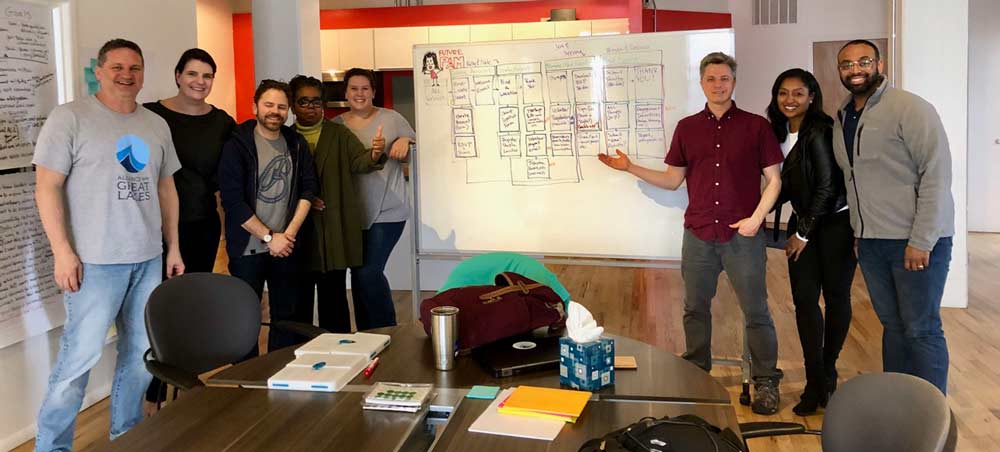
If possible, facilitate customer or other stakeholder journey mapping workshops with a group of about five to eight people.
- Include too many people and the workshop becomes unwieldy or hard to manage.
- Invite too few people and you might not have diverse enough perspectives.
Who you invite depends on the journey you hope to map. In an ideal world, you include diverse stakeholder representation. This will foster more lively discussions. Alongside a seasoned facilitator, you want a blend of organizational decision makers, sales and marketing leads, customer service representatives, and, most importantly, actual customers.
Also, if customer representatives aren’t available, be sure your team understands that decisions made during the workshop are based on assumptions that need to be validated or refuted. To that end, follow up with qualitative interviews to ensure customer perspectives are well-represented in the research.
Stakeholder Mapping Guide
Related content: This stakeholder mapping guide can help you better understand whose perspectives to enlist when mapping a customer or other stakeholder’s journey.
Journey Map Fidelity
As an artifact of design processes, customer journey maps range in fidelity based on their purpose.
- Low-fidelity: Rough sketches, typically informed by assumptions, created during workshops to quickly convey a hypothesis or idea.
- High-fidelity: Detailed maps, backed by research and designed to create clarity across stakeholder groups about consensus on the best path forward.
However a team utilizes journey maps, they should be flexible enough to evolve as your team learns new things. Fidelity shouldn’t get in the way of flexibility.
Current State vs. Future State Journey Maps
Similarly, journey maps often come in two flavors:
- Current state: A current state journey map helps you understand what your customers are doing right now. This is very helpful to define existing gaps in service or customer pain points.
- Future state: A future state map is aspirational and can help to hypothesize the means by which you address pain points in a current state map.
Rigorous journey mapping often requires both. However, if a product or service doesn’t currently exist, future state mapping is your best bet. Again, back it up with research.
Crafting Circular Customer Journeys
By default, customer journey maps tend to be linear. However, customer experiences are often ongoing.
This is especially true if:
- An organization is hyper-focused on meeting its customers’ needs,
- It offers subscriptions, refills, or other reasons for customers to continue using their products or services,
- A dedicated customer service team is committed to improving every step of a customer’s journey.
The customer journey mapping process will help you identify opportunities to re-engage and delight customers by improving experiences throughout a product or service’s life cycle.
In other words, prioritize relationships and think about your sales and marketing efforts as a flywheel instead of a funnel. You’ll find more opportunities for mutual success and shared trust this way.
Adding Impact to the Customer Journey Mix
Additionally, journey maps offer great opportunities to help customers make more responsible or sustainable choices during their interactions with your organization.
Ways to do this include:
- Choice architecture: Help customers identify more sustainable options, such as lower emissions shipping or more sustainable packaging, for instance.
- Sourcing: Showcasing local or more ethically sourced products or services.
- Filtering: Allowing customers to filter based on different sustainability criteria, such as water, energy, or emissions impact.
When identifying customer touch points and emotional states in the journey mapping process outlined below, ask whether there are opportunities to improve social or environmental impact while also prioritizing a top-notch experience.
Step-by-Step Customer Journey Mapping
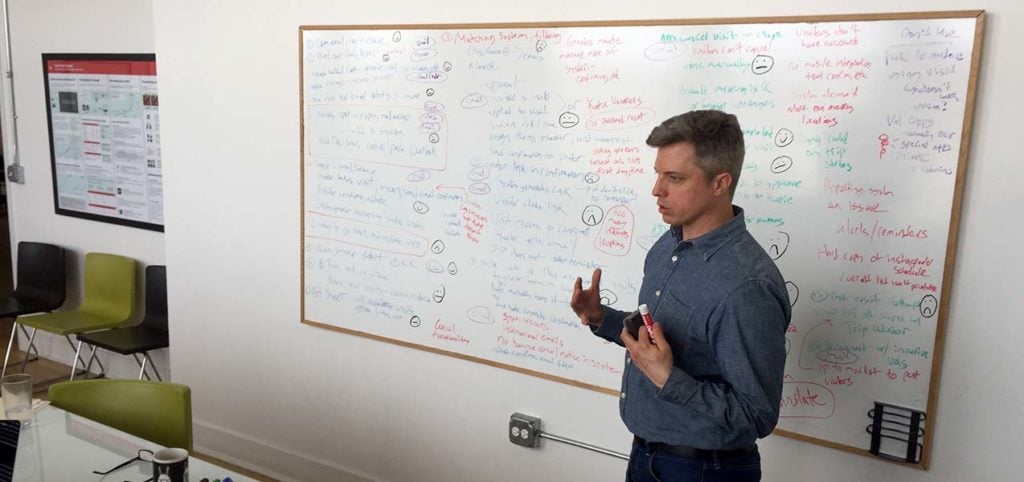
Customer journey maps are best created in a collaborative workshop setting. For this workshop, we incorporate a combination of brainstorming and whiteboard exercises to give more depth to the map.
Use the five steps below to create your own customer journey map.
Step 1: Gather Research
To kick off the journey mapping process, collect specific feedback from customers. You might have this already or you might need to conduct research to identify the necessary data.
- Quantitative: Data collected from surveys, analytics, social media, and other sources can help you identify customer experience trends.
- Qualitative: Research conducted through stakeholder interviews, observation, or other qualitative methods can drive deeper insights.
Also, competitive intelligence will help you get a sense of what others in your industry are already doing.
Customer personas can sometimes plays a helpful role in defining customer wants or needs. However, these are usually based on assumptions or broad characteristics.
Choose a research method and amount of work that you feel will produce the best results without wasting time or producing unnecessary data. This will provide a solid foundation to better understand your customers’ wants, needs, or specific pain points.
Step 2: Touchpoints and Channels
To produce useful insights that will help you better understand why customers might be dissatisfied or frustrated, first define two things:
- Touchpoints: the specific interactions customers have with your brand (contacting customer service, listening to a sales presentation, and so on).
- Channels: the methods by which communication happens (emails, phone conversations, social media, in-person meetings, etc.).
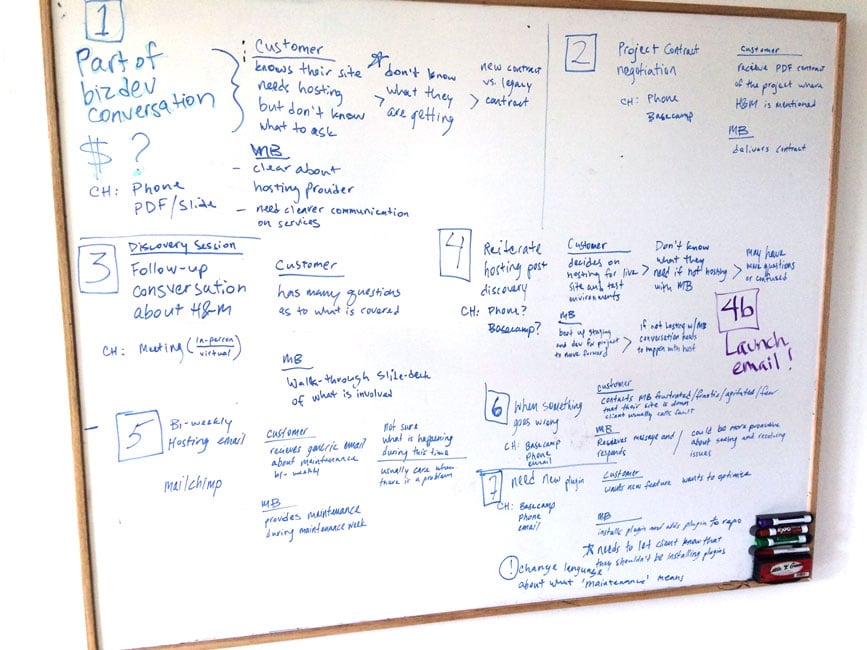
Create a list of touchpoints that start with the time a customer first interacts with your organization through to scenarios where they might close out the service or stop using a product. For each touchpoint, define the most commonly used communications channels. Use a whiteboard to sketch out the timeline for these touchpoints and included channels through which that contact occurred.
Step 3: Empathy Mapping
Using the touchpoint timeline, conduct empathy mapping exercises. These can help you better understand a customer’s mindset during the interactions defined above.
The goal of these exercises is to get a well-rounded understanding of how customers actually feel during specific interactions and cross-reference those with how we hope they will feel.
During this discussion we ask common yet specific questions, like:
- What is the client’s tone of voice when they call about a product or service?
- Are they contacting us because a product or service fell short for some reason?
- Are they confused about something in particular?
- What kinds of customer support questions do they ask?
- Are their questions technical in nature or do they relate to how we communicate a specific feature or benefit?
After answering these questions as a group, write down single words or short phrases on sticky notes for each touchpoint to describe how a customer felt during the interaction.
Next, follow these up with aspirational words to describe what you hope customers will feel at each touchpoint. Place the sticky notes in columns under each touchpoint.
This encourages conversations about how to improve interactions during each touchpoint. If the discrepancies between actual and aspirational emotions are significant, mark them as priority items for an affinity diagram.
Step 4: Solutions, Opportunities, and the Affinity Diagram
The above steps serve as a foundation for creating an affinity diagram, which is a brainstorming exercise artifact meant to:
- Define potential solutions to a problem.
- Uncover opportunities for improvement.
- Group ideas together based on commonalities.
Affinity diagrams can be created in many ways, including:
- Whiteboard sticky note clustering
- Dot voting
- Color coding
- And so on…
These processes connect similar ideas with one another so that potential solutions address multiple pain points.
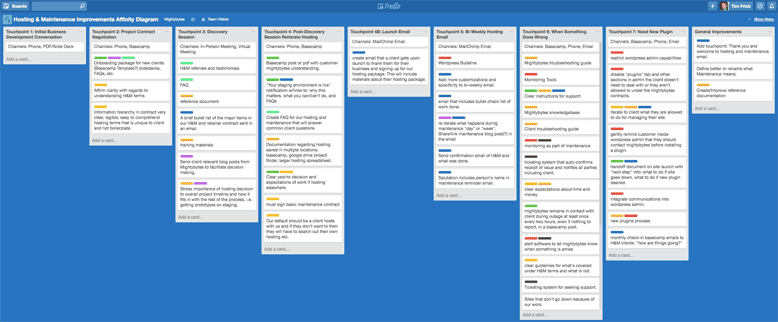
Reviewing channels, touchpoints, and feelings should uncover ample opportunities to improve your product or service. To create an affinity diagram relevant to your customer journey map:
- Discrepancies: Note discrepancies between actual and aspirational feelings for each touchpoint. Discuss each in detail with your team.
- Opportunities: Define potential opportunities for fast improvement by identifying those discrepancies which can be easily or quickly fixed.
- Possible solutions: Devise several solutions for each touchpoint to help transition negative opinions into positive experiences. If possible, estimate how long each might take.
- Grouping: If applicable, group similar solutions together to identify efficiencies or places where you might get the most traction with one solution across multiple touchpoints.
- Prioritize: Make the most egregious discrepancies, where customers are potentially most frustrated, your biggest priorities.
Identifying the low-hanging fruit will help you make quick fixes, which will no doubt be appreciated. However, understanding where the largest gaps between customer frustration and customer satisfaction exist will likely have the biggest impact. Ultimately, this will create more happy, long-term customers.
Step 5: Creating the Final Customer Journey Map
Finally, create a visual representation of the entire customer journey which represents all of the above steps:
- Insights from your research
- Touchpoints
- Channels
- Feelings
- Potential solutions
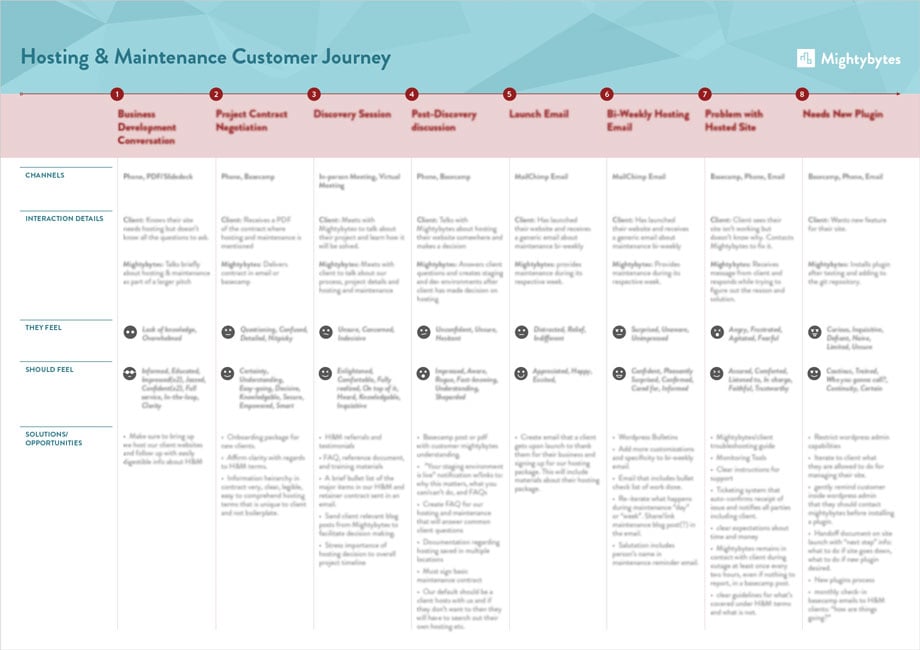
How you visualize a customer journey map will depend on the product or service you hope to improve. Some customer journey maps rely heavily on statistics, infographics, and data visualization. The map below focuses on solutions and opportunities over time with brief descriptions of each.
Journey Mapping Digital Products and Services
Customer journey maps can be used to improve all existing products, services, or programs across digital and non-digital touchpoints. For instance, if one of your organizational goals is to increase donations, mapping out the entire journey a customer follows should reveal numerous useful insights. Stopping at digital touchpoints will quickly reveal shortcomings in this approach.
Isolating each digital and non-digital touchpoint along a journey will reveal many opportunites to:
- Understand your customer’s experience in great detail,
- Better comprehend their motivations and empathize with their situation,
- More accurately determine how you might improve their experience.
For instance, a donation journey might be improved via several means:
- Clearer, more compelling calls-to-action across email marketing, social media, advertising, or direct mail channels
- More streamlined and accessible donation forms that make it easy for anyone to donate
- Easier access to customer support options, including how-to emails, landing pages, service bots, links to specific items in a knowledge base, or a number to call if they want to talk to a real human
For our customer journey map example above, we defined as many as fifty potential improvements to our website hosting and basic maintenance service. While we didn’t execute every idea generated, the list was long enough and the ideas in it strong enough that we had plenty to work with for many years.
Sustainable Customer Journey Mapping
Customer journey mapping offers organizations a valuable toolkit to build trust and improve relationships over time. In turn, this also impacts more traditional business metrics like reducing customer churn, improving loyalty, or driving revenue.
With that said, journey maps are most useful if you maintain or revisit them over time. Revisiting your map—and the processes it visualizes—will help your team stay on track with continuous learning and improvement.
To improve your journey map’s usefulness, consider it a living document maintained and updated as problems get fixed, new touchpoints are added, or customer experiences change. This will also offer repeated opportunities to improve the product or service’s sustainability as well.
In other words, make it a regular priority to revisit your customer journey map. Everyone will appreciate the effort.
Customer Journey Mapping FAQs
If you regularly field questions about your product, service, or program and notice consistent customer complaints or frustration, you’re likely a good candidate for customer journey mapping. However, to reap the best benefits, you also need a customer experience-focused team willing to make the changes a journey mapping process reveals.
Customer journey mapping is not a one-and-done affair. Regularly revisiting journey maps over time will reveal numerous opportunities to identify and address potential weaknesses in customer experience. Frequency and velocity will depend on the nature of your product, service, or program.
However, you will achieve the highest levels of success by giving someone ownership of journey mapping activities alongside a mandate to improve performance over time.
While invitees will depend on which elements of a customer’s journey you plan to review, it is always best to include a variety of perspectives, especially those whose journey your intend to map. Just keep in mind that the larger a workshop gets, the more challenging it becomes to facilitate. For this reason, consider capping workshops at 5-8 people.
If necessary, you can always run multiple workshops.
In tandem with other human-centered design and co-creation activities, journey mapping can be used across organizational stakeholder groups to improve experiences, build community, and create meaningful strategic partnerships grounded in mutual trust and respect.
While it’s certainly possible to create a journey map outside of a workshop setting, incorporating diverse stakeholder perspectives into the co-creation process will reduce chances for confirmation bias and making decisions based solely on your own assumptions.
Responsible Digital Strategy
Learn more about how Mightybytes uses responsible digital strategy to position our clients for long-term success.