Advancing Economic Digital Responsibility
In this article, we explore how economic digital responsibility impacts technology-related financial decisions. We also explore more regenerative and equitable solutions you can use in your own organization.
Technology drives global economic change on a scale the likes of which we’ve never seen before. The 4th Industrial Revolution produces 3D-printed schools, climbing robots, sensor-powered agriculture, and of course the explosion of generative AI. This redesigns the very fabric of society.
New breakthroughs happen every day while more established digital disciplines—like marketing and product design—continue to evolve at breakneck speed, especially with new developments in artificial intelligence.
The Fourth Industrial Revolution is about more than just technology-driven change; it is an opportunity to help everyone, including leaders, policy-makers and people from all income groups and nations, to harness converging technologies in order to create an inclusive, human-centred future.
— World Economic Forum
The real opportunity is to look beyond technology, and find ways to give the greatest number of people the ability to positively impact their families, organisations and communities.
According to the U.N. Trade & Development’s Digital Economy Report, the digital economy is booming:
- Annual smartphone shipments have more than doubled since 2010.
- Internet of things (IoT) devices are projected to surge to 39 billion by 2029.
- New data from 43 countries, representing about three quarters of global GDP, show business e-commerce sales grew nearly 60% from 2016 to 2022, to reach $27 trillion.
However, with rapid growth comes rebound effects and a slew of Big, Wicked problems as well. From unintended social and environmental consequences to tools implicitly designed for deception, economic progress has come at great cost to some while leaving others behind entirely.
Understanding this, is there a set of ethical, responsible, and more sustainable economic principles that can govern our entire digital economy? From the smallest agencies to Big Tech companies, including organizations just getting started with digital transformation—how should we proceed?
Designing A New Economic System
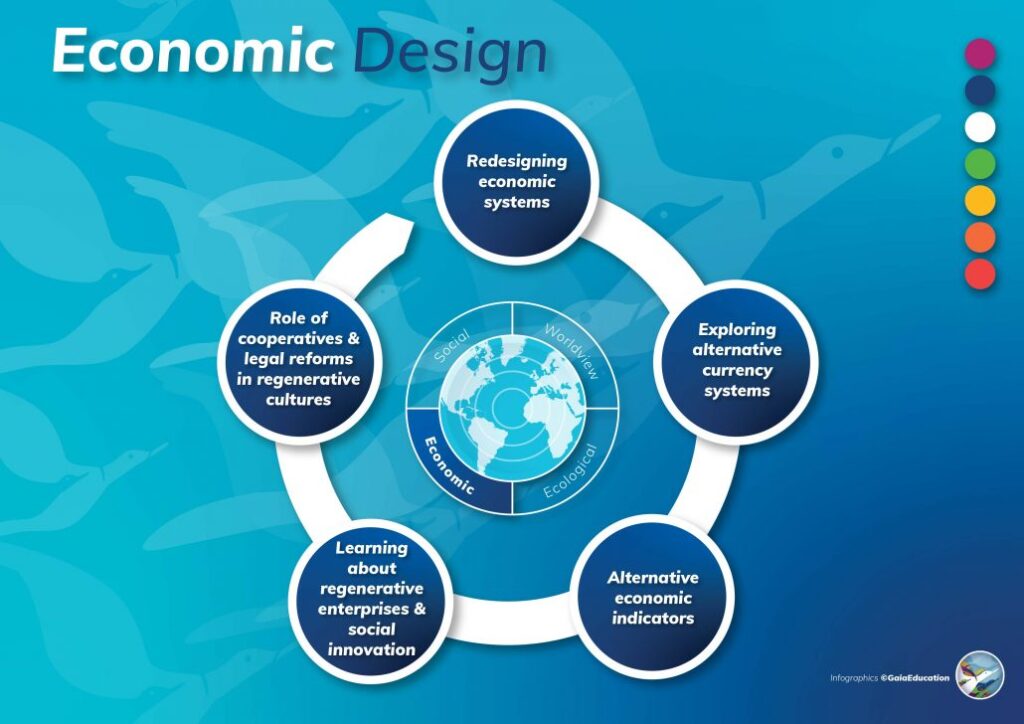
I was recently privileged to co-facilitate the Economic Design course of Gaia Education’s Design for Sustainability program, which focuses on designing regenerative cultures. The course explores alternative currency systems and economic indicators, social innovation, cooperatives, alternative legal structures (like benefit corporations), and other important practices necessary to redesign our economic systems so that they work better for everyone. This is mission-critical work.
Since 2011, Mightybytes has been part of the global B Corp community. Our collective mission is to build a regenerative, equitable, and more inclusive economy that works for everyone.
As a digital agency, we are committed to using design, technology, and marketing to create a better world. Therefore, focusing on this work—and helping our clients do the same—is core to how we implement our mission.
With technology playing such a key role in this long overdue economic transition, responsible digital practices must live at the heart.
One conclusion from the 100+ social and environmental mission companies I have interviewed is that focusing on sustainability and being responsible leads to more effective business operations overall and as a result better financial performance.
— Christopher Marquis, Better Business: How the B Corp Movement is Remaking Capitalism
Defining Economic Digital Responsibility
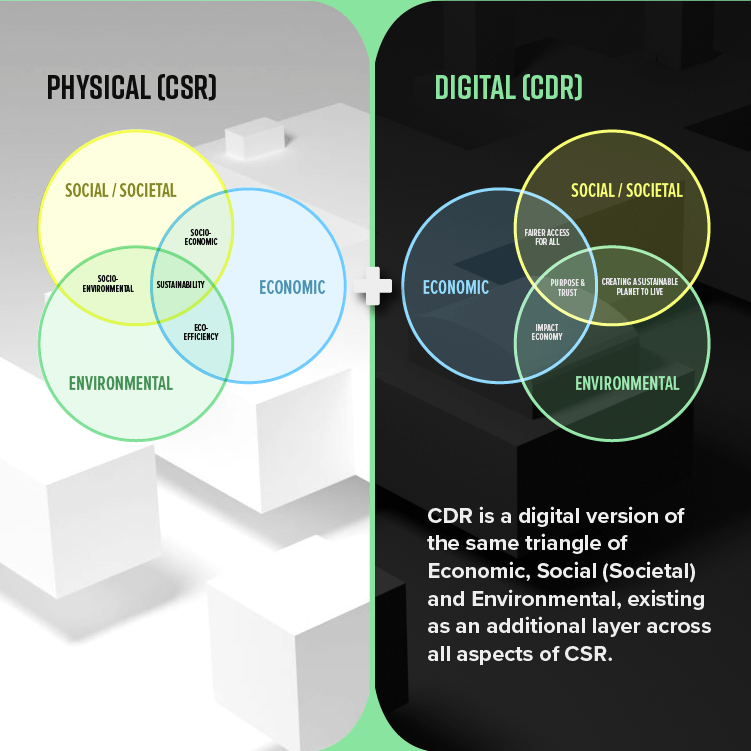
Economic digital responsibility, one of several categories of corporate digital responsibility, concerns itself with the financial and economic impacts of an organization’s technology decisions. Since economic digital responsibility is directly related to how organizations make money and share in the benefits of digital products and services (or not), it arguably offers the biggest potential to close income inequality gaps, address systemic racism, and build an economy that works for everyone.
It inspires many questions for conscientious leaders looking to make informed and economically sound decisions. For example:
- Will the people you employ or contract for digital projects be fairly compensated?
- Are there other unintended financial consequences that could arise from your technology choices?
- Have you explored opportunities to more equitably share the economic opportunities that arise from digital products or services?
- In the race to adopt emerging technologies, who is being financially neglected?
- Are there opportunities to create new digital-native positions within organizations that are economically feasible as well as rewarding and engaging?
Answers to these questions sit at the heart of economic digital responsibility. Here are some things you can do.
Ubiquitous JEDI
First and foremost, justice, equity, diversity, and inclusion (JEDI) should play a key role in economic digital responsibility. Both the tech and sustainable business communities are predominantly white and majority male. Despite recent large-scale pushback on ESG and DEI initiatives across the corporate sector, we can still do better.
Practices described below won’t reach their true potential if people from underrepresented or otherwise marginalized communities are not active participants. This includes hiring practices, but also the businesses you support as well.
A broader, more diverse set of stakeholders always contributes to better solutions. Likewise, a company that supports more diverse organizations will be a better business. For everything you do, take a step back, reflect, and ask: who is being left out?
Cutting Corners on Tech
We see it all the time: organizations cut corners on technology investments to get results faster. Suddenly a prototype, which was never meant to be a final product, goes live. A complex digital product becomes a slapdash conflagration of plugins and APIs, loosely bound together with the virtual equivalent of dental floss and chewing gum.
Invest Responsibly in Digital Products and Services
Unfortunately, cutting corners on large digital projects leads to security risks, privacy breaches, user frustration, increased churn rates, and technical debt—the accumulation over time of code that needs refactoring to ensure long-term viability.
What’s more, this also undermine’s your organization’s digital resilience with potentially much bigger economic impacts.
While this happens in the private sector, it runs rampant in nonprofit and civic projects due to lack of resources and, specifically, how projects are funded.
Also, digital agencies are notorious for underbidding projects in order to win the work. Once this occurs, they must scramble to deliver something passable on time and under budget. Often, these deliverables are subpar because the project wasn’t appropriately funded or given a realistic timeline. This is an all too frequent side effect of the broken RFP process.
Technical Debt & Sustainability
Related content: Learn how cutting corners on tech projects increases risk and undermines both sustainability and an organization’s long-term viability.
An economic mindset shift for your next digital product could increase your chances for long-term success:
- Think product, not project: Good product management practices, like effective prioritization and user research for instance, will help you make measurable progress toward your goals. This can drive more responsible financial decisions over time.
- Budget for outcomes, not outputs: If possible, earmark funds annually—or better yet, quarterly—for digital work and ditch the finite project budgets. Outputs are easy to quantify, but will they help you actually reach your goals? Outcomes—like a significant change in customer behavior, for example—are much more desirable. Unfortunately, they are also harder to shoehorn into the constraints of a finite project budget.
- Map your stakeholder ecosystem: Stakeholder mapping can reduce your chances for unintended consequences and help you more broadly understand who (or what) might be affected by your product or service. This can directly impact financial decisions.
- Agility and continuous improvement: Similar to the first two points above, test-driven methods to measure success and drive continuous improvement are more economically sound. Embrace failure as a learning opportunity—it will save you time and money in the long run.
More importantly, increased capital should become available to projects with both financial and social or environmental value at their core. Impact investing must become the norm as opposed to the outlier. However, that’s a different post for another time.
Tech accountability is currently a popular call — whether it be from government, civil society, media, or inside the industry itself — but what does it mean if related efforts are not centered on the rights and protections of those workers within the tech industry? Real reform will only come from the combined efforts of workers, external advocates, and regulators.
— Ifeoma Ozoma, Employer-Tied Healthcare is Also a Tech Accountability Issue
For workers to be able to disclose information that can be used to demand and ensure accountability, there must be a basic level of safety in place, and there’s nothing more basic than access to physical and mental health care.
Living Wages, Improved Benefits
At Mightybytes, we guarantee everyone who works for the company—employees and contractors—is paid the equivalent of a living wage as a baseline. We also strive to maintain a small compensation ratio of lowest-to-highest paid employees.
In addition to paying a living wage, we offer the best benefits our resources will allow. These range from ‘standard’ benefits like health insurance and retirement savings to more intangible benefits like flex time, predictable hours, prioritizing work/life balance, ongoing educational opportunities, and so on.
However, tying healthcare benefits to employment can also trap people in positions for a variety of reasons. This approach requires companies in some industries to rethink their balance sheets and, in some cases, their business models.
The research exists: a living wage and access to good benefits improves both the economy and quality-of-life. Let’s prioritize this for digital positions and across society at large.
Uber set out to build a tool that democratized access to cars. It ended up building a tool that further impoverished the poor. The service model was fine, but the financial model it used for growth could only ever be as ethical as the people who strove to benefit the most…Silicon Valley has exhibited total comfort with destroying the social fabric of humanity to make a profit.
— Mike Monteiro, Ruined by Design
Outsource Responsibly
If you’re using external vendors, audit their practices to ensure workers have fair wages, work-life balance, and good benefits. It might be tempting to accept that offshore offer for low-cost programming services, but does it also support worker exploitation? Find out before making a decision.
Low gig economy wages have advanced income inequality while also reducing the quality of digital solutions. Gig economy companies are often criticized for short-changing people who use their platforms to generate income.

Also, while these contracts provide flexibility, they don’t come with paid sick leave, parental leave, vacation days, healthcare benefits, workers’ compensation, or any number of benefits that contribute to an overall social safety net.
More importantly, gig jobs don’t offer protection from discrimination. Since there’s also no means for collective bargaining, gig workers are vulnerable to wage or hour violations. The artificial intelligence industry, for example, outsources data labeling tasks, sometimes for as little as $8 per day. We can do better.
Our Ethical Marketing Agency Guide
Related content: This comprehensive guide can help you identify traits to look for in an ethical agency partner.
Replace Human Jobs Responsibly
Companies across the economy are in a mad dash to replace human workers with AI tools in the name of ‘efficiency’. However, up to 95% of these efforts are largely unsuccessful. But it doesn’t have to be this way.
Instead, when new technologies require teams to reorganize, upskill or cross-train interested employees. These additional skills related to the company’s products and services can significantly reduce employment disruption.
Better yet, build education into the company’s business model to ensure that cross-training and upskilling are core to how you create shared value.
Education Impact Business Model
Related content: Good education is the cornerstone of an equitable and more sustainable future. Our Impact Business Model in this area enables us to fold educational components into every project as a core value that drives both social impact and commercial success.
If the global cooperative economy were a single economic unit, its $20 trillion combined asset base would make it the fifth largest economy in the world. That’s all to say that cooperatives are far more common, and more economically significant, than you might think.
— Cameron Madill, Five Reasons Our B Corp Became a Worker Cooperative
Sharing Economic Benefits
In 2020, Cameron Madill transitioned his agency PixelSpoke from a single-member LLC to a worker-owned cooperative. He offered five primary reasons for the transition:
- Living his beliefs: Cooperatives are a tool for teaching democracy through doing.
- Reducing inequality: Co-ops offer paths to ownership that might otherwise be out of reach for some.
- Increasing employee engagement: The cooperative structure offers opportunities to improve stability, productivity, and growth potential.
- Ensuring long-term sustainability: Sharing ownership allows co-ops to create more robust leadership structures focused on long-term viability.
- Stimulating change: Shared ownership can reduce stagnation and help organizations prioritize continuous improvement.
While transitioning to a worker-owned cooperative may not be an option for every organization, there are other ways that conscientious leaders can commit to sharing economic benefits of their digital work with stakeholders.
For example, digital-native companies—like agencies, software startups, and so on—might offer profit-sharing programs, free or low-cost educational events, free or reduced-fee accounts, or other philanthropic initiatives. Mightybytes, provides free educational events and audits financial performance annually to prioritize team bonuses.
Shared value isn’t always financial in nature either. You might also consider contributing to an open source project. If you create photos, videos, or other forms of digital content, release them under a Creative Commons license. Consider the forms of capital your company offers and brainstorm ways to share in their benefits.
Respect Data Ownership Rights
Respecting data privacy and ownership takes many forms. This includes combating software piracy to appropriate image licensing and legal contracts for digital projects. Each has financial and, in some cases, legal ramifications. While we’re not providing legal advice here, some things to consider include:
- Implement policies to ensure appropriate licensing and attribution are always used in digital projects or content.
- Give people the right to be forgotten. New privacy laws like GDPR or CCPA dictate that if a customer requests deletion from your marketing database, you must comply.
- Similarly, offer informed consent. Those same laws mentioned above might make it illegal for you to set a cookie in a user’s browser, for instance.
Scientists, researchers, public opinion, and policymakers agree that with these new technological advancements comes a degree of responsibility to make sure that the next generations will live in a safe, trustworthy, and inclusive digital environment.
— IEEE, Corporate Digital Responsibility: Securing Our Digital Futures
Often, innovation comes with a price, and it is our collective responsibility to focus on future digital technologies in terms of responsible design thinking and development, and how such technologies are sustainable and used to avoid unintended consequences.
How AI Impacts Economic Digital Responsibility
Finally, we cannot cover economic digital responsibility without mentioning the emerging impacts artificial intelligence creates. Generative AI creates new industries while laying waste to others. In the process, businesses close and people lose their ability to thrive.
We need to ask ourselves important questions:
- Who has access to tools and data being used to drive economic change within our organizations?
- Who benefits from the outcomes of this economic change?
- Is decision-making equitably distributed when new products, services, policies, and programs are introduced within an organization?
- Are organizational stakeholder perspectives represented throughout the lifecycle of these products and services?
- Are employees offered opportunities to learn new skills in the face of technological disruption?
If we truly want to create an economy that works for everyone, technological disruptions must be managed more ethically and sustainably with organizational stakeholders centered in processes and decision-making.
Ethical & Sustainable AI
With so many challenges inherent to responsible AI adoption, is ethical and sustainable AI even possible? We explore answers in this article.
There is a greater percentage of people living in poverty now than in 1969 and their degree of poverty is more severe, on the order of third world countries. Families living on $2 a day. People should not be living like that in America or anywhere, for that matter. . .
— Glen Hendrix, Economists Have Been Lying to Us for Decades
Inequality of wealth is now greater than at any time in history because modern technology allows the purchase of so much more personal power and influence at a relatively small price.
Responsible Tech Advocacy Toolkit
Advocate for responsible tech policies that support stakeholders with this resource from the B Corp Marketers Network, published on B the Change.
Economic Digital Responsibility: Last Word
Economic Digital Responsibility is a huge topic that impacts so many different types of organizations across sectors, industries, size, geography, and so on. To distill all this information down into a single article outlining both impacts and potential solutions is no small feat.
With that said, economic reform and sustainable digital transformation must occur in tandem for society to thrive in the 21st century and beyond. Organizations should start thinking in systems and planning for long-term resiliency as quickly as possible.
Plus, in order for a stakeholder-driven economy to drive long-term progress, systemic change must occur. This doesn’t happen without improving standards, creating industry guidelines, and enacting new legislation. Every responsible digital company must also become an advocacy engine.
Hopefully, the topics covered in this article offer a stepping stone to jumpstart your own efforts. As always, if you want to discuss anything in this post, feel free to contact us or message me directly on LinkedIn.
Responsible Digital Strategy
Learn more about how Mightybytes uses responsible digital strategy to position our clients for long-term success.