The Cone of Uncertainty
In this article, we share how the Cone of Uncertainty impacts projects and explore ways you can use it to improve collaboration, build trust, and create better outcomes across organizations and teams.
Key Takeaways
- The cone of uncertainty highlights that projects have diminishing uncertainty over their lifecycle, impacting risk and collaboration.
- Embracing the cone of uncertainty fosters innovation, allowing teams to adapt as new insights emerge during projects.
- Organizations can better navigate uncertainty by adopting strategic foresight and participatory design practices.
- A growth mindset and collaborative discovery processes help teams address uncertainty, leading to improved outcomes.
- Operationalizing these methods enhances relationships, builds trust, and fosters long-term project success.
Inevitable Uncertainty
Whether implementing a new process, starting an innovation project, or redesigning a product or service, organizations want to reduce risk when taking on new initiatives. However, the list of unknown criteria at any project’s outset is usually very long. This is especially true if said project requires third-party expertise and a client/vendor relationship is new.
Unfortunately, these factors can exacerbate, rather than reduce, project risk.
While experience might support some risk reduction guardrails, no team can predict the future. Plus, up-front uncertainty makes people uncomfortable. This is especially true if they know they will be held accountable for success.
What’s more, our brains are hard-wired for predictability. Uncertainty triggers stress hormones in the amygdala. Thus, we consider unknowns as a threat.
However, innovation happens in the margins between uncertainty and new learning. How might we strike a proper balance between these two things?
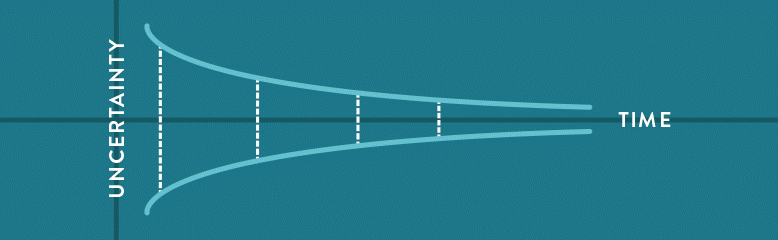
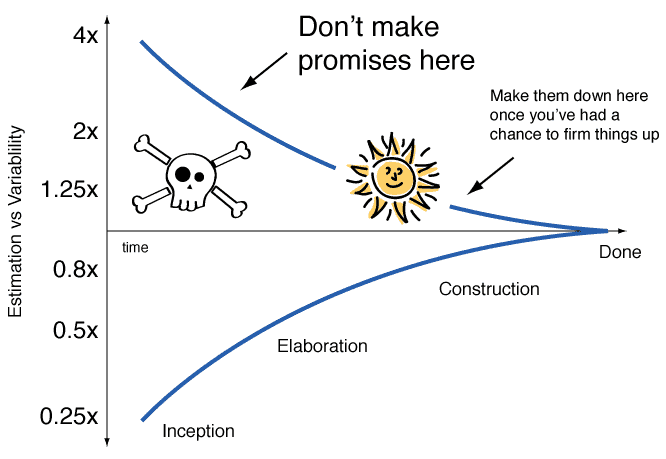
The time between project negotiation and understanding exact specifications is often referred to as the Cone of Uncertainty. If not managed effectively, it can wreak havoc on projects, teams, and organizations.
By embracing uncertainty rather than trying to control it, teams can better position themselves, their organizations, and their projects, for enduring success.
The Cone of Uncertainty
The cone of uncertainty concept originated in 1950s engineering and construction management. Its simple premise is that any project has a diminishing range of uncertainty during its life cycle. As new information is received and learning occurs, uncertainty narrows, enabling teams to more accurately estimate workloads, budgets, timelines, and so on.
Unfortunately, many teams complete all financial and contractual negotiations up front—during the period of highest uncertainty. This poses significant problems, especially when multiple parties are involved.
While detailed specs are helpful, committing to every task, feature, and design requirement up front restricts freedom to deliver a better project as you learn new things along the way. In reality, once everyone rolls up their sleeves and dives in, great ideas arise:
- Discovery workshops lead to brilliant new feature ideas.
- Stakeholder interviews lead to insights that weren’t considered during the negotiation process.
- Sprints uncover better, faster, and cheaper ways to implement project specs.
Because contractual terms were already agreed to, these ideas don’t often reach their potential. Uncertainty undermines success.
Reconsider that RFP
Related content: Learn how Requests for Proposals (RFPs) can potentially undermine project success in this guide.
Uncertainty vs. Opportunity
What’s more, strictly adhering to contractual terms set up front reinforces a project culture grounded in negativity. By constantly trying to maintain scope, budget, and legal obligations, vendors have no choice but to gently rebuff requests not discussed up front as part of the contractual terms. Otherwise, scope creep starts.
Sure, you can put all the new ideas into a ‘phase two’ list for later implementation. But what if some of those ideas could fundamentally change the project’s potential for success?
Why not embrace the cone of uncertainty instead and build processes and practices that specifically address uncertainty early on in meaningful ways? This makes for better outcomes, higher value projects, and happier stakeholders.
Unfortunately, that’s not how many projects work. However, there are better ways…
Embracing the Cone
A growth mindset grounded in learning and curiosity can help teams better address uncertainty. To achieve this, up front, collaborative, stakeholder-driven discovery processes and breaking projects into small, manageable chunks with built-in mechanisms for feedback and collaboration can help.
Plus, this is needed more than ever at a time when AI is inserted into almost every design and development process, regardless of whether or not it provides value. True innovation happens when humans collaborate to solve problems together based on shared goals and experience. AI can greatly enhance this experience, but it should never be considered a replacement for it.
More agile organizations weigh variability, test assumptions, and commit to working on the highest value deliverables first. By prioritizing deliverables, they solve the biggest problems first and leave lesser challenges to later in the project, when timeline and budget might be tighter. This helps them mitigate risk and use the cone of uncertainty to everyone’s advantage.
Embracing uncertainty can help with initiatives at the organization, project, and team levels.
In a survey of 550 business leaders, 21% said they feel unprepared to adopt emerging trends. Another 59% felt neutral to somewhat prepared…looking at several futures before you plan builds that flexibility in before you need it.
— IDEO, Why You Should Add Futures Thinking to Your Strategy Process
1. Organizations: Strategic Foresight
In times of volatility, chaos, and disruption, organizations that utilize strategic foresight practices, like Futures Thinking, Anticipatory Design, Applied Futuring, and others are better positioned to deal with uncertainty than those that don’t. These disciplines enable organizations to better prepare for uncertain futures that might take one or more of many shapes:
- Projected: The ‘business as usual’ future where little, if anything, changes.
- Probable: Strong quantitative trends drive high probability of specific events occurring.
- Plausible: Current laws of nature and social systems drive futures that could very well happen.
- Possible: New knowledge, technologies, or shifts emerge that could drive a possible future.
- Preposterous: A future that is considered ridiculous or outside current understanding.
- Preferable: Normative value judgments representing what we want to happen, which can cut across or sit outside the other categories.
Incorporating strategic foresight practices can help organizations, and the teams within them, better prepare for uncertainty and disruption as a projected future evolves into something else.
2. Projects: Practical Design Discovery
Next, Design Thinking and participatory design practices enable project stakeholders to frame problems and identify potential design solutions together, which will, in turn, address uncertainty. That process typically goes something like this:
- Empathize: Understand the needs of stakeholders affected by your project or initiative.
- Define: Clearly state core problems and challenges experienced by a specific stakeholder group.
- Ideate: Generate a wide range a potential solutions that prioritize quantity and variety over perfection.
- Prototype: Create low-fidelity versions of the most viable ideas.
- Test: Gather real-world feedback from actual stakeholders on the prototypes.
More importantly, a rigorous discovery process grounds business relationships in mutual trust and a shared commitment to providing the best solution possible. When these elements are present, facing uncertainty becomes a great deal easier.
Time makes up your life, so wasting it is actually a slow form of suicide.
— Jeff Sutherland, author of Scrum: The Art of Doing Twice the Work in Half the Time
3. Teams: Test Assumptions
Moreover, a naturally curious team that embraces failure and puts methods into place to validate or refute assumptions about features, goals, or other specifications is better primed for enduring success. This growth mindset enables continuous learning and improvement over time among teams. By default, this addresses uncertainty as it arises.
Transitioning to Agile
Related content: Learn how to ground your work in continuous improvement and improve organizational agility in this article.
Embracing Uncertainty on Your Next Project
Uncertainty on a large project or initiative can cause stress across teams and organizations. Nobody wants that. It undermines good mental health and well-being and causes all sorts of often unnecessary strife.
However, organizations that operationalize the practices outlined above will form stronger relationships with better chances for long-term, shared success. Expectations are managed. Promises are kept. Trust is maintained, so relationships thrive. Everyone wins.
More importantly, the Cone of Uncertainty becomes something project stakeholders address together as a natural extension of how they work rather than something they create unproductive workarounds for or unnecessary stress over.
Uncertainty
FAQs
Here are some commonly asked questions about reducing risk and embracing uncertainty.
No project is without risk. However, by embracing uncertainty through collaborative discovery engagements, sharing risk and expectations with stakeholders, and testing assumptions as you go, you can increase chances for enduring success on a project or organizational initiative.
While RFPs might feel like a viable way to control uncertainty at a project’s outset, the reality is that they often undermine success more than they enhance it. This is because rigid RFP requirements, typically approved up front before a project begins, can put unreasonable constraints on a project or team tasked with executing a new initiative.
Controlling uncertainty is human nature. Uncertainty triggers stress hormones like cortisol and adrenaline in the brain. Because of this, we naturally gravitate toward predictability and try to control uncertain situations so they move toward predictability.
Generative AI tools can help you answer research questions and fill in data gaps during up-front discovery processes. However, because they are largely trained on information from the existing internet, they are not very good at detecting signals to indicate future trends. Therefore, they might not be the best tools to use for addressing uncertainty associated with what could happen (versus what has happened or is happening now).
Enlisting stakeholder perspectives into collaborative strategy processes is a useful way to frame problems and co-create then validate or refute potential solutions meant to address uncertainty. While this is not a sure-fire method to ward off risk, it will help you achieve a broader understanding of potential unintended consequences that might occur with your project or initiative.
Responsible Digital Strategy
Learn more about how Mightybytes uses responsible digital strategy to position our clients for long-term success.