How to Successfully Navigate a Homepage Redesign
Use this article to manage multiple stakeholder expectations during a homepage redesign process.
It’s an all too common scenario: everyone wants their product, service, event, or program included in the new homepage redesign. A website homepage is valuable real estate. Plus, even small organizations have many stakeholders.
So begins the juggling act of balancing organizational goals with user needs:
- Under these circumstances, how can you redesign a homepage that keeps organizational stakeholders happy while also ensuring target users’ needs are met?
- Longer term, how should you manage stakeholder content expectations over time to ensure your homepage continues doing its job?
Clearly understanding stakeholder needs, coupled with good content governance practices, can set your next redesign up for success. In this article, we explore how.
Key Takeaways
- User needs: Manage multiple stakeholder expectations during a homepage redesign by balancing user needs and organizational goals.
- Editorial committee: Establish a diverse editorial committee to oversee content decisions and maintain a clear governance process.
- Mapping stakeholders: Utilize stakeholder mapping and consistent meeting cadence to address material needs and maintain engagement throughout the redesign process.
- Data-driven research: Leverage metrics and user research to guide design revisions and mitigate emotional bias in decision-making.
- AI deployment: Implement AI tools responsibly to enhance efficiency while ensuring human oversight and content quality during the homepage redesign.
Many Stakeholders, One Homepage Redesign
Deciphering homepage priorities can quickly become contentious during a redesign. Personal opinions, organizational goals, and many other factors play roles in what can be a challenging process.
Plus, featuring a specific program or department on an organization’s homepage—especially for websites that get millions of visits per year—can make a big difference in meeting both business goals and user needs.
In our experience, clearly understanding your stakeholder ecosystem plays a critical role in how organizations should prioritize each group’s material needs.
Below are a few practical content governance strategies that you can employ to ensure success for multiple stakeholders during a homepage redesign and over time.
Mapping Stakeholders
Unsure about the material needs of your stakeholders? This stakeholder mapping workshop can help.
Responsible Content Decisions
With the advent of AI, organizations increasingly deprioritize human oversight on content-related initiatives. Unfortunately, this often results in ‘AI slop’ and reduced content quality, which further disengages audiences already besieged by a glut of mediocre content clogging their feeds.
To counteract this, write from personal experience that prioritizes your expertise and creativity. AI tools can be useful for content creation but they will never replace the value of these traits.
Most importantly, prioritize telling a compelling story that will inspire the people you hope to reach.

Content Strategy in the Age of AI
Related content: Use these nine steps to create a sustainable content strategy in the age of artificial intelligence.
Establish a Governance Committee
Difficult decisions about what to feature on the homepage become more challenging with too many decision makers. This complicates and bloats a homepage redesign process.
A governance committee is useful not only during a homepage redesign, but in ongoing editorial, content, or digital and data governance efforts as well. More importantly, a committee can lead the process of creating meaningful guidelines if those don’t already exist at your organization. Ultimately, this improves organizational resilience.
Choose a single representative from each department or program among your organization’s stakeholders. Empower these representatives to make decisions about digital products and services or, more specifically, the homepage redesign project.
Be sure to consider the following when establishing this committee:
- Demographic diversity: Who’s not represented that should be?
- Responsibilities: Who is responsible for which decisions? How is accountability managed?
- Deliverables: What will the committee be responsible for?
- Term of Service: Will the committee be responsible forever or just during the homepage redesign?
Editorial Guidelines
Related content: Learn how to improve content consistency with editorial guidelines.
Data Governance: Translating Guidelines for AI Tools
Similarly, AI tools won’t understand editorial or design guidelines out of the box, even if you publish them on your website. You’ll need to do a few things before your guidelines and the AI tools you use match up.
- Write editorial guidelines and design standards in machine-readable formats, like markdown.
- Understand the difference between global rules and individual tasks in your AI system. File editorial guidelines in the former category.
- Once your content or design files are created, add an AI-powered workflow step to check for style consistency.
Meeting Cadence
Even if your product or service changes daily, weekly, or monthly, it’s important that the committee meet with predictable frequency. This is especially critical during a homepage redesign. We have seen homepage redesign projects that take as little as a few weeks or as long as a few months.
Establish meeting frequency based on what works well for your project and your team. For the redesign, your committee is responsible for approving which content ends up on the homepage, so they should remain engaged. Otherwise, the project will drag on and content quality will suffer.
Here are several other benefits to regular meetings:
- Managed stakeholder expectations
- Consensus through collaboration
- Improved content migration processes and editorial consistency
Plus, creating this committee can reduce (but not eliminate) last minute requests for homepage features. Set the expectation that if someone doesn’t get you copy or images on time, they lose their homepage slot. This puts the burden directly on stakeholders to maintain reasonable timelines.
Content Governance Planning
Some organizations plan content campaigns months or even years in advance, not just when they’re redesigning a homepage. Regular editorial committee meetings can help with longer term content governance planning as well.
Set a few ground rules to manage expectations:
- If your organization has a clear content strategy, make sure everyone understands it.
- An actionable content governance plan will help the committee establish guardrails on stakeholder requests over time.
- Similarly, clear content workflows will empower individual stakeholders to better understand both process and expectations.
You’re not just planning to launch a new homepage, though that’s an immediate need. Your goal is to effectively manage a successful digital product over time. If you can’t accommodate someone’s needs in a week, perhaps you can do so during the following week, month, quarter, etc.
Clear content governance will help with this.
Your Content Governance Plan
Related content: A good content governance plan sets the tone for managing stakeholder content expectations. Learn how to create one in this article.
Review Metrics Before a Homepage Redesign
Reviewing content metrics will help stakeholders objectively understand what’s working and what’s not. User research methods can inform this process, especially if your editorial committee doesn’t have the data capacity or understanding to review Google Analytics goals, for instance.
A/B testing is also quite helpful in providing objective content performance data. With A/B testing, a certain percentage of website visitors is shown a variant design while the remainder receive the original or ‘control’ variant. Once a test reaches statistical significance, you can better understand which option performed better.
Make time for your homepage redesign task force to review performance metrics early in the process. Metrics review sessions with clear goals can also help people make decisions based less on emotions and more on empirical evidence. This brings us to the next point.
Managing Design Revisions
If you’re not careful, design revisions can eat up a redesign project’s budget and timeline. Design is often a subjective process. People lead with their personal feelings rather than empirical data. It is important to have a combination of each. In addition to reviewing the metrics mentioned above, setting guardrails on a design process will help.
At Mightybytes, we typically budget for two rounds of design revisions:
- Round one: More significant revisions when design comps are first presented in order to reach stakeholder consensus.
- Round two: A second round of minor, usually cosmetic tweaks to refine the page.
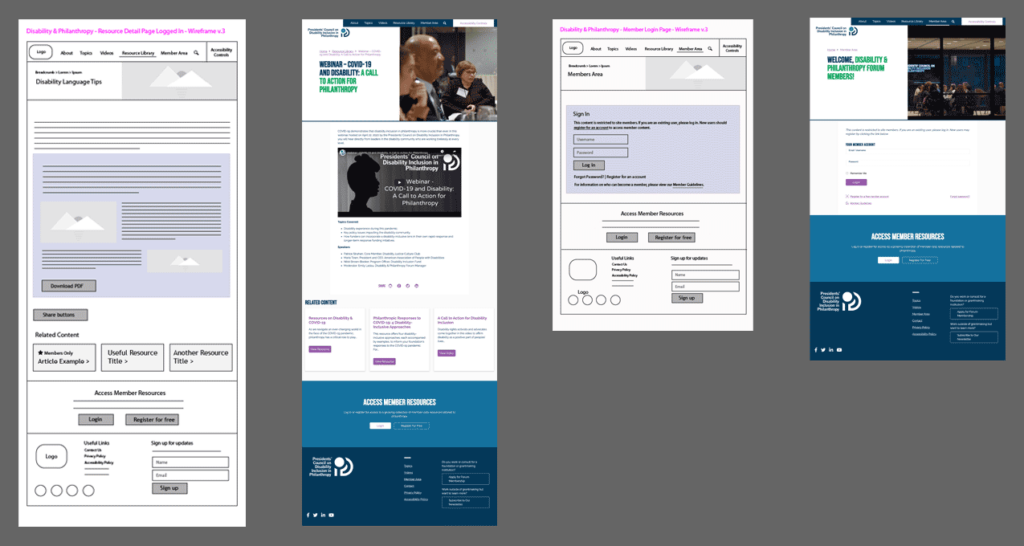
If a third round of revisions is required, we have conversations about timeline and budget. Of course, project stakeholders will have already seen page wireframes and, possibly, prototypes for page layout options. By the time we’re reviewing comps, the process should go quickly.
Testing a Homepage Redesign
There’s an often cited study by cognitive psychologist George A. Miller that shows people can only handle seven (give or take) pieces of information at one time unless they are broken down into smaller chunks. That’s why our ten-digit phone numbers include three groups of numbers separated by dashes.
In other words, fewer options will likely improve a user’s experience. For many reasons—including aesthetics—avoid a “kitchen sink” approach to redesigning your website’s homepage. Not sure if you’ve passed this threshold with your new homepage design? Test it.
Wireframes or clickable prototypes test whether a design is intuitive or clearly actionable. They’re most commonly employed in tandem with user interviews to establish whether or not a proposed feature idea or page layout resonates with target users. If a user can’t quickly find what they need, you probably have more work to do.
Establishing Stakeholder Priority
Unfortunately, your target users’ actual needs are often lost in the internal shuffle of a homepage redesign. Plus, office politics and organizational structure often dictate whose decision passes muster. This can lead to poor performance on your business goals. It also frustrates users.
With this in mind, how do you establish stakeholder priority when it comes to homepage content? Consider these ideas:
- Establish submission guidelines and an editorial process for homepage content.
- Give everyone access to your content calendar and ensure they follow it.
- Solicit ongoing feedback from target users through customer service, UX design, or marketing channels. Incorporate that feedback into future iterations.
Of course, this approach won’t work for every organization. However, it’s a good start to streamline a homepage’s editorial process.
AI and Your Homepage
AI tools can streamline many of the processes mentioned above. However, to reduce risk, organizations should put responsible policies in place that prioritize human oversight. It should also be someone’s job to enforce these policies.
Here are just a few ways AI can complement the process of a homepage redesign:
- Synthesize collected data from stakeholder interviews or workshops
- Quickly prototype design concepts in or out of a workshop setting
- Audit an existing homepage for improvement opportunities
Remember, while vibe coding can offer speed and efficiency benefits, it also comes with significant risk factors, including potential security, data privacy, and accessibility issues, to name just a few. Human oversight is critical.
Responsible AI Policy
Related content: With AI tools and practices changing so often, organizations should consider enacting a Responsible AI Policy. Feel free to borrow from ours for your own use.
Know When to Compromise
Finally, you can’t please everyone all of the time when it comes to website content. However, with some clear guidelines and content governance practices in place, you can manage expectations during a homepage redesign and beyond. It is an ongoing balancing act. But it is doable.
Most importantly, know when to compromise and when to evoke the governing documents described in this post. Not only will it make your homepage redesign go more smoothly. It will keep the peace with organizational stakeholders as well.
Frequently Asked Homepage Redesign Questions
Here are answers to some of the most frequently asked questions we receive about homepage redesigns.
While stakeholder perspectives are critical to large projects like website redesigns, incorporating too many can undermine, rather than enhance, the process. The number of stakeholder perspectives you include will depend on several factors, including project scope, timing, budget, and availability.
Find the right blend between internal and external stakeholders to keep scope manageable. For example, limiting workshop attendance to between five and eight people can make activities easier to manage. If necessary, conduct several workshops and use AI tools to synthesize the insights.
Your homepage will never satisfy everyone. Plus, attempting to do so will result in a cluttered page that ultimately serves no one.
For research, be sure to at least include primary and secondary users in stakeholder interviews and workshop sessions alongside other important groups like website admins, users with disabilities, and so on.
Performance data can help you make a powerful case against swoop and poop, where leaders dictate homepage priorities, often ignoring what the research says. To combat this, track homepage performance over time to make a data-driven case for changing content. Better yet, conduct A/B testing to track the swoop and poop decision against other options.
However, if you’re in a very hierarchical organization, there might not be much you can do.
Qualitative and quantitative user research can help your team make more educated homepage redesign decisions. Specific testing methods include stakeholder interviews, analytics tracking, A/B testing, surveys, heat mapping, and so on.
Choose the method that’s best for you based on what you hope to achieve with the research.
As one of a website’s most popular destinations, homepages provide incredible opportunities to better understand what people actually want from your content. As such, consider rethinking how you approach them.
Instead of a wholesale redesign, consider the homepage as a fertile testing ground for new ideas. Create hypotheses based on user research, then test those hypotheses to validate or refute each idea. With this approach, your homepage becomes a living document that’s always changing as opposed to something you need to redesign outright every few years.
Inclusive Experience Design
Learn more about how Mightybytes uses inclusive design strategies to help our clients strengthen stakeholder relationships while meeting their business goals.